One of the most distinctive sound characteristics of the shamisen is the buzzing noise that occasionally appears while playing. This sound is usually associated with the sitar and often surprises listeners at first.
This buzzing is called sawari and reflects the influence of the biwa on the development of the shamisen. In fact, this buzzing sound is a defining characteristic of the biwa’s tone.
When Sawari Occurs
Sawari is heard on the thick string, ichi no ito, and occurs when the open string strikes against a resistance. There are two mechanisms that create this effect: (1) a notch in the kamigoma and (2) an adjustable mechanism called Azuma Sawari. In the first method, the string vibrates against the sao (fingerboard), while in the second, it strikes a small wooden block that can be adjusted in height.
The sawari sound occurs not only when the thick open string is plucked but also when it resonates strongly due to harmonics played on other strings. Depending on the quality of the instrument, it may produce more or less sawari in response to harmonics. High-end instruments stand out because their sawari effect is particularly responsive and can be triggered by harmonics even in distant tonal ranges.
How the Buzzing Sound Is Created
When a string is plucked, it begins to vibrate. While a still string lies flat and motionless, a vibrating string oscillates. Even though this happens at high frequency, one can sometimes see the string “wobbling” with the naked eye. If a resistance is placed at the right distance, the oscillating string will strike against it, producing the distinctive buzzing sound. It is crucial that the resistance is positioned correctly—too close, and it will dampen the vibration prematurely before it reaches full amplitude.
The Two Sawari Mechanisms

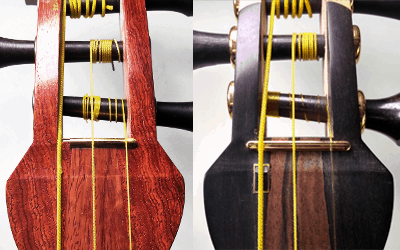
left: the simple mechanism | right: azuma sawari
The Simple Sawari
With the simple sawari, the thick string sits lower than the others due to a notch in the kamigoma. This deliberate lowering of the string allows it to vibrate against the sao near the tenjin. As seen in the image below, the string sits significantly lower near the tenjin (left) than near the dou (right), where the strings rest on the koma. This extra depth enables the string to strike the wood, creating the buzzing sound. However, because the ideal distance for the buzzing effect is fixed, the simple sawari only works within a limited pitch range. If the string is tuned too high or too low, the effect diminishes and eventually disappears altogether.

Here it’s easy to see: the strings are lower at the head (left) than at the body (right).
The Azuma Sawari
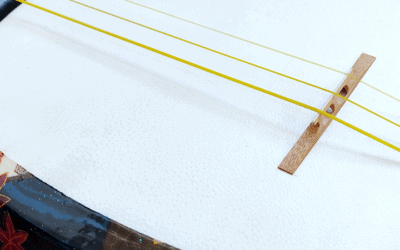
Azuma Sawari is an adjustable mechanism installed under the thick string in the sao. A small wooden block can be moved up or down using a screw mechanism. The string is also slightly lowered at the kamigoma, but not enough to strike the sao on its own. By adjusting the height of the wooden block, one can completely eliminate the buzzing sound by lowering the block or enhance it by raising it. This allows the player to fine-tune the sawari effect to their preference and maintain it across different tunings and pitch ranges. For shamisen players accompanying singers, tuning must be adapted to match the singer’s vocal range. With the azuma sawari, players can enjoy a full sawari sound even at extreme high or low tunings.

The lowered wood block mutes the buzz.

Raised wood block for a full sawari.
Learning to Love the Sawari
Beginners are often confused when their shamisen starts buzzing unexpectedly. Many perceive it as an unwanted noise and try to suppress it. While everyone has their own taste in sound, sawari appreciation often comes with exposure and experience.
I encourage anyone who isn’t immediately drawn to the shamisen’s buzzing and humming to give it a chance. The sawari enriches the tone, making it fuller and more dynamic, adding an extra dimension to the sound. Personally, I get chills when I hear the electrifying buzz and often linger on notes with a lively sawari when improvising. To me, it feels as if the instrument is coming alive, responding to me.
I sincerely hope that more players can experience and enjoy these moments. With this article, I hope to have opened the door for some to join the community of sawari enthusiasts.
I encourage anyone who isn’t immediately drawn to the shamisen’s buzzing and humming to give it a chance. The sawari enriches the tone, making it fuller and more dynamic, adding an extra dimension to the sound. Personally, I get chills when I hear the electrifying buzz and often linger on notes with a lively sawari when improvising. To me, it feels as if the instrument is coming alive, responding to me.
I sincerely hope that more players can experience and enjoy these moments. With this article, I hope to have opened the door for some to join the community of sawari enthusiasts.
Watch the video here: