The good news: the yubisuri is one of the essential tools for playing shamisen, and you can easily make it yourself. Knit it, crochet it, or cut it from old gloves—there are many ways to get the job done. The really easy version I’m showing today is sewn by hand from elastic band. The instructions are also available for free download on Patreon.
Material
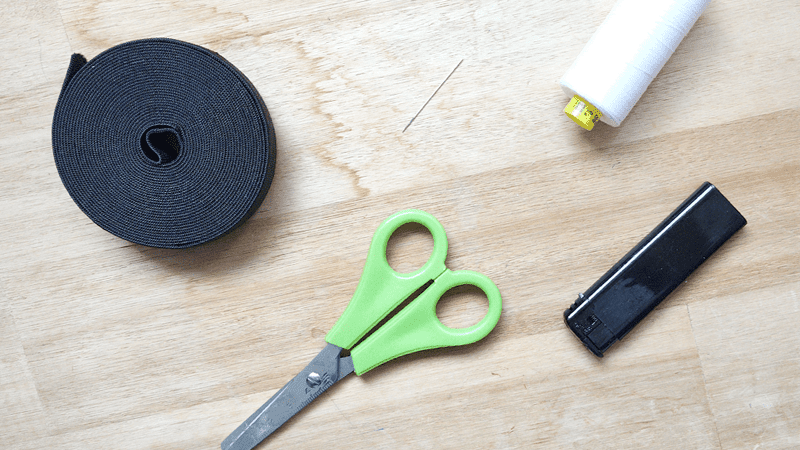
Our basic kit is simple:
– sewing needle
– thread
– scissors
– lighter
– 20 mm wide elastic band (about 25cm total)

That’s all you need to sew a yubisuri.
Elastic bands can usually be found in the haberdashery section of department stores, or you might have a well-stocked friend with some at home for repairing trousers—just ask around.
The finer the needle, the easier it will go through the material. Standard sewing needles, often included in emergency kits, work perfectly for this project.
I actually recommend avoiding a sewing machine for this one because there’s so little to sew, and the setup would have to be adapted to use a machine.
The Plan
To turn the piece of elastic into a Yubisuri, we follow three steps:
1. measure and prepare the materials
2. sew the rings
3. attach the rings to the bridge
Step 1: Measure and Prepare
We need three pieces of elastic: one for the thumb ring, one for the index finger ring, and one for the bridge.
When cutting, keep edges as straight as possible and carefully seal with a lighter to prevent fraying.
You can measure each piece directly on your hand. No seam allowance is needed, but add about 2 cm extra for the bridge.
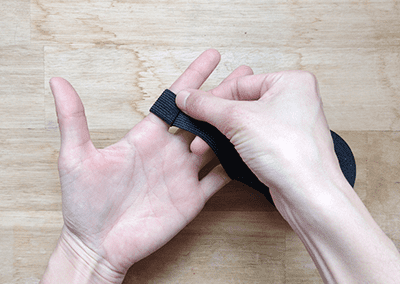
Wrap elastic around your index finger.

Wrap elastic around your thumb.
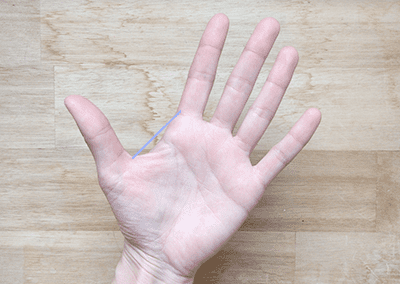
For the bridge, measure the distance between thumb and index finger.
Step 2: Sew the Rings
Close the ends of each ring by stitching them together. There are many techniques for this; I’m showing the simplest one, which works for beginners and creates a flat, comfortable seam. If you prefer other techniques, go ahead!
The most important thing is not to pierce too close to the edge, as the material can tear despite sealing.
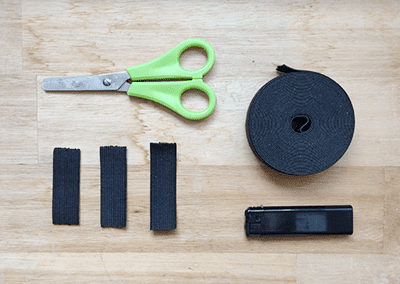
Once the parts are cut, carefully seal the edges with a lighter to prevent fraying.
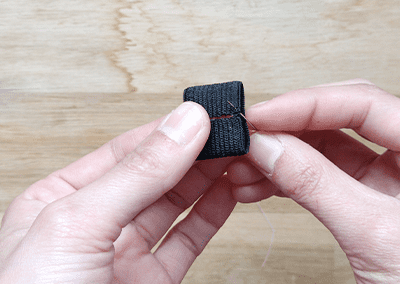
Insert the needle close to the edge and sew the piece into a ring.
Step 3: Attach the Bridge
Next, connect the two rings with the bridge. Position the bridge directly over the seams to reduce stress on the stitching and increase durability. For maximum stability, I recommend sewing the bridge seams twice, either with backstitches or by going around twice.
Help
If you have shaky hands, joint issues, or poor eyesight, consider asking a friend for help. With a little sewing experience, this small project is quick and easy. A sunny day picnic is a great opportunity—bring your materials and enjoy crafting outdoors!
PDF Instructions
If you like working with PDF instructions, you can download the PDF for this project for free on Patreon. If your elastic band is particularly stiff, meaning not very stretchy, I recommend adding 1 or 2 mm extra material so the Yubisuri doesn’t feel too tight.