A Few Words Before We Begin
The following are my favorite stretches and mobility exercises for relaxing the shoulders and upper back. They’re all done standing, without equipment. A flat surface and enough space to reach up and to the sides are all you need.
Move with control — slowly, intentionally, and with awareness of muscle engagement.
At the end of each motion, pause for a few breaths and feel the tension consciously. Ask yourself: Where exactly do I feel the stretch? Can I deepen it safely? Is my spine straight?
When returning to a neutral stance, do so gently rather than collapsing out of the pose.
Exercise 1: The Pillar
- Stretch your arms overhead, interlace your fingers, and push your palms upward as if trying to hold up the sky.
- Keep your arms long and your spine straight — avoid arching your lower back.
- Hold for a few breaths, then lean gently to one side.
- Maintain active extension through your hands and arms.
- Return to center and repeat on the other side.

Extend arms over your head and push the hands away from you.

Maintain the tension and gently bend to one side.
Extend arms over your head and push the hands away from you.
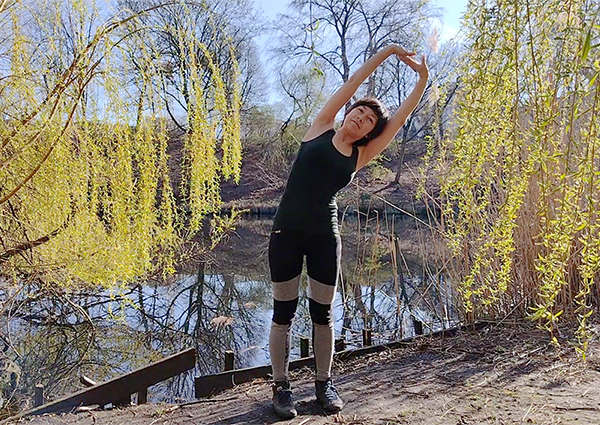
Maintain the tension and gently bend to one side.
Exercise 2: The Elbow Poke
- Reach one arm up over your head.
- Bend the elbow so your hand moves toward your back.
- With the opposite hand, grasp the bent elbow and gently pull it inward toward your head.
- Keep your head upright; don’t let the arm push it forward.
- Switch sides and repeat.

The hand reaches toward the bent elbow.

Gently build up tension.

Keep your head straight. Don’t let the arms push forward.

The lower hand slides down along the back.
Exercise 3: The Handshake
- Place the back of one hand on your lower back, reaching up.
- Reach the other arm from above your shoulder, palm facing inward toward your back.
- Try to bring your fingertips together or even clasp them if possible.
- Switch sides and repeat.

Push the hand towards your neck from below. The other hand reaches from above.

Find the fingers of the other hand and then grasp them.
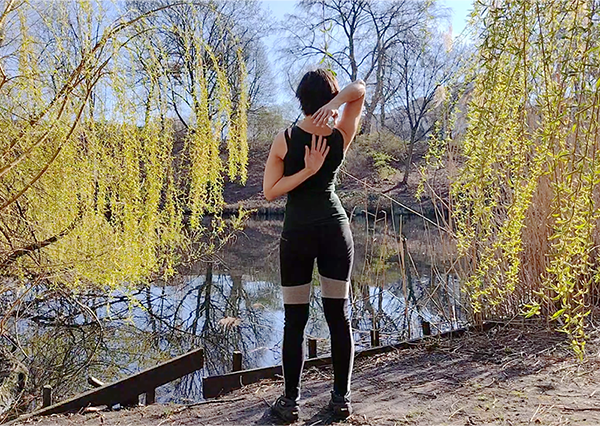
It’s just as confusing on the other side 🙂

If flexibility is limited, simply sliding the hands toward each other is sufficient.
Exercise 4: The Folded Star
- Stand in a wide, stable stance – like a no-trespassing-man — feet slightly wider than shoulder-width. Stretch the Arms sideways away from your body, as if someone would pull on them.
- From your lower back, rotate your torso diagonally downward toward the floor.
- One hand reaches toward the center point between your feet.
- Keep both arms tense and extended away from your body throughout the motion.
- Hold tension for a few breaths, then return and repeat on the other side.

No-trespassing-man: stand in a stable stance and vigorously stretch the arms sideways away from your body.

Without moving the arms, rotate the upper body diagonally downward from the lower back.

One hand reaches toward the center point between your feet.

Repeat the same on the other side.
Exercise 5: The Tilted Windmill
- Start in a wide, stable stance.
- Reach one arm down toward the opposite foot.
- Extend the other arm upward in the opposite direction, forming a “windmill” shape.
- Turn your head to look up at the raised hand.
- Remember: Keep both arms actively pulling away from each other and lengthen your spine.
- Return to standing and repeat on the other side.

We start off in a stable stance.


Repeat the same on the other side, looking up toward the raised hand.
Exercise 6: The Marionette
- Begin with feet shoulder-width apart.
- Keeping your spine straight and your gaze forward, tilt your upper body sideways from the hip.
- Don’t bend your spine — let the movement come from the hip joint.
- Extend both arms out and look toward the upper hand.
- Keep your back long and your arms engaged.
We start off in a stable stance.

Tilt sideways from the hips with a straight back, keeping your gaze forward.

Tilt as far as you can with a straight spine. Your hand doesn’t have to touch the foot, but it should reach for it.

Bring your arms into a “no-trespassing-man” position and stretch them apart, looking up toward the raised hand.
Exercise 7: The Chicken
- Stand comfortably with your feet together.
- Place your hands on your shoulders — right on right, left on left.
- Draw large circles with your elbows.
- engaging your shoulders actively.
- After a few rounds, reverse the direction.

Find a relaxed stance and place your hands on your shoulders.

Draw large circles with your elbows.

Activate your shoulders.

Nice big movements!

If it looks less tilted than in my example, that’s a good sign.
Change directions after a couple of rounds.
Exercise 8: The Cactus
- Stretch your arms straight overhead, fingers spread wide.
- Slowly pull your elbows down to the sides as if dragging down an invisible weight.
- Squeeze your shoulder blades together and pull your elbows back and down.
- Keep your chest open and tension active throughout.
- Raise your arms again and repeat several times.

Engage your arms and hands when you reach up.

Pull the outward-spread elbows gently downward in a controlled movement.
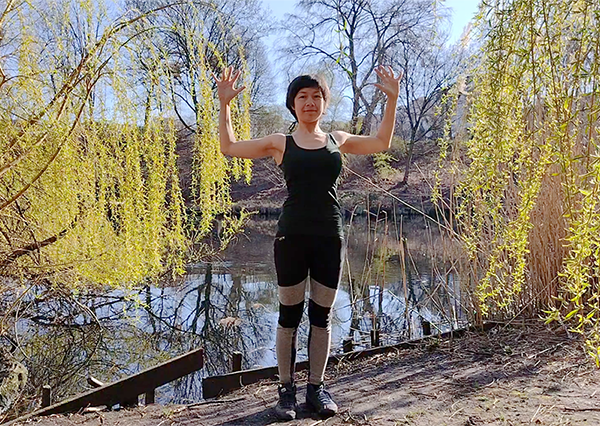
Squeeze your shoulder blades together and pull your elbows back and down.

Keep the tension engaged. Don’t let the elbows slip forward.
Exercise 9: The Hammer
- Choose your stance: Option A: Step one foot forward into a split stance. Option B: Stand with feet wide apart.
- Extend your arms behind your back and clasp your hands into a fist.
- Pull the fist downward and away from your hips.
- For a deeper stretch, hinge forward at the hips with a straight back, keeping your arms extended.
- Stretch your arms as long as possible.
The images on the left side show the exercise in option A stance. The images on the right show the same exercise with option B stance.

Option A: Step one foot forward into a split stance.
Option A: Wide stance.

Clasp your hands behind your back into a fist and pull them down and back.


A: slowly tilt forwards. Keep the tension in your arms.

Here’s how it looks in position B. Lean forward slowly, keeping the tension in your arms.

Tilt as far as it feels comfortable.


Then keep stretching your arms farther away from your body until your shoulders feel nicely worked and loosened.

Mix & Match
You can do these exercises in any order. What matters most isn’t the shape, but the tension and control in each movement. Even if a pose looks passive, stay actively engaged — that’s what makes these stretches effective.
Afterward, you’ll feel relaxed yet energized, with your shoulders pleasantly worked out.
With practice, it becomes easier to feel where the tension is and how to release it through proper alignment.