
The Three Classic Shamisen Tunings
Every shamisen player should master three basic tunings that you can set without much thought. Most traditional pieces use one of these tunings, and you’ll often find folk songs arranged in multiple tunings. These three tunings are:
本調子 Honchōshi
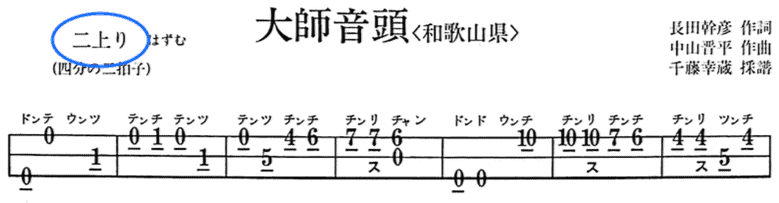
二上り Niagari
三下り Sansagari
These tunings connect logically, making them far less mysterious than they first appear. Once you understand the symbols, moving between tunings becomes intuitive. You’ll typically find the tuning notation in the upper left corner above the piece.
本調子 Honchōshi
Honchōshi literally means “base tuning”—your default starting point. While the exact root note isn’t fixed, C is standard nowadays, especially for purely instrumental pieces without vocals or flute. The characters break down as:
本 origin / base
調子 tuning
Using C for the thick string (ichi no ito), Honchōshi tunes to C3–F3–C4. The interval from thick to middle string is a fourth, middle to thin string is a fifth. Don’t worry about technical names—you just need to tune correctly.
Here’s my memory trick: from thick to middle string, it sounds like “Amazing Grace,” and from middle to thin string, it sounds like “Twinkle, Twinkle, Little Star.” Everyone knows these melodies! Definitely give it a try.
The other two tunings build from Honchōshi, and their names tell you exactly how to get there.
Note: When accompanying singers, adjust the tuning to match their range. Men often need lower tuning (sometimes down to A, making strings feel loose), while women may need higher tuning (up to E, making strings feel stiff).
二上がり Niagari
Niagari literally translates to “raising the second”—referring to the middle string (ni no ito).
二 two
上り raise
三下り Sansagari
Sansagari means “lowering the third”—you lower the thin string from Honchōshi by one whole note.
三 three
下り lowering
Instead of C3–F3–C4, you get C3–F3–B4b. Forget note names if they confuse you—instead, use your ear!
For Sansagari, thick to middle string sounds like “Amazing Grace,” and middle to thin string too sounds like “Amazing Grace“.
Quick Retuning Trick
There are also a few technical tuning tricks worth knowing—both to prevent peg breakage and to keep the pegs firmly in place so the strings stay in tune. Be sure to read the tuning tips article if you haven’t yet; it’ll make your life a lot easier.
Pro tip: No tuner for C? No problem! When playing solo (without other instruments or singers), choose any comfortable pitch for your thick string. I prefer Bb—it sounds warmer to my ear. What matters is maintaining the correct intervals between strings (“Amazing Grace” and “Twinkle, Twinkle, Little Star”).
Watch the video here: